57° RoadsCams
Boat on the water in a cover on Lake Tahoe

Lake Tahoe History & Culture

It All Starts with the Lake: About Lake Tahoe

Lake Tahoe is a freshwater lake located in the Sierra Nevada, sitting at an elevation of 6,225 feet and spanning across California and Nevada. It’s the largest alpine lake in North America, with an average depth of 1,000 feet—making it the second deepest lake in the United States. Lake Tahoe holds around 39.75 trillion gallons of pure freshwater and is one of the clearest lakes in the world.

Explore the North Lake Tahoe Region

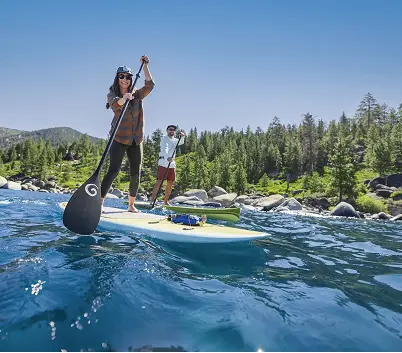
North Lake Tahoe spans the west, north and east shores—from Emerald Bay to Spooner Summit—encompassing 70% of the Lake Tahoe region and 52 miles of shoreline. It is known for its serene beauty and wide array of year-round outdoor adventures—on the lake and in the mountains, with hundreds of miles of hiking, biking, and ski trails. No matter what part of North Lake Tahoe you visit, you’re surrounded by nature.

The North Lake Tahoe region has 12 towns: Kings Beach, Tahoe City, Incline Village, Northstar, Olympic Valley, Crystal Bay, Homewood, Tahoma, Carnelian Bay, Tahoe Vista, Tahoma, and Donner Summit. North Lake Tahoe is home to 11 downhill ski resorts including Palisades Tahoe, Northstar California, Diamond Peak, Mt. Rose, and Homewood Mountain Resort, and two mountain villages with The Village at Palisades Tahoe and The Village at Northstar. The region includes many state parks across California and Nevada, including Emerald Bay State Park (where you can hike the Rubicon Trail and explore the Scandinavian architecture of Vikingsholm Castle), and Sand Harbor State Park (where you can walk the East Shore Trail and marvel at the iconic granite boulders of the east shore).

Want to know more about how Lake Tahoe became what it is today?

Go ahead and dive in.

Lake Tahoe formed over two millions years ago through powerful tectonic and volcanic forces, later shaped by glaciers into the deep, clear lake we see today.

Movement along faults in the Earth’s crust caused large land blocks to rise and fall. As the Tahoe block dropped, the adjacent Sierra Nevada and Carson Range blocks uplifted. These tectonic forces created the Lake Tahoe Basin and the surrounding mountain ranges.

Although glaciers did not carve out the Lake Tahoe Basin itself, several alpine glaciers shaped nearby valleys such as Emerald Bay, Fallen Leaf Lake, and Taylor Creek. These glaciers left behind moraines, polished granite, and other features still visible today.

Later, volcanic activity from Mt. Pluto (at Northstar) created a lava dam at Tahoe’s northwest outlet near the Truckee River. As the Basin filled with snowmelt and precipitation, the dam eventually eroded, forming modern-day Lake Tahoe and the Truckee River.

Tahoe’s boulders have been fractured and moved by natural processes for millions of years. Water seeps into cracks, then expands as it freezes, widening fractures in a process known as freeze-thaw weathering. Frost heaves also lift and shift boulders as freezing water in the soil expands. Look around and you can see these forces shaping the landscape, even creating balancing rocks and cracks large enough for trees to grow out of stone.

MORE RESOURCES
UC Davis Tahoe Science Center
USFS Geology of the Lake Tahoe Basin
Tahoe National Forest Information Page
The Washoe Tribe (Wašiw) are the original inhabitants of the Lake Tahoe region, with a cultural presence that stretches back more than 10,000 years. For the Washoe people, Daʔaw—Lake Tahoe—is the center of their world, a sacred place woven into their stories, traditions, and identity.

For thousands of years, Washoe families spent their summers at Lake Tahoe fishing, gathering plants and holding ceremonies along the shoreline. They moved with the seasons—harvesting pine nuts in the fall, living in sheltered valley camps during the winter and returning to the mountains in spring. Their deep knowledge of the region’s plants, animals, and waters continues to guide their stewardship today.

The Washoe are renowned for their outstanding basketry, a tradition exemplified by master weaver Dat So La Lee, whose finely crafted baskets are celebrated around the world. Despite the challenges brought by colonization and displacement in the 1800s, the Washoe Tribe has maintained its cultural strength and enduring connection to Lake Tahoe.

Today, the Washoe Tribe of Nevada and California continues its work to restore traditional lands, revitalize the Wašiw language, and protect the health of Daʔaw. Their presence and leadership remain central to the ongoing story of the Lake Tahoe Basin.

MORE RESOURCES
UC Davis Tahoe Science Center
Gatekeeper’s Museum

Tahoe history tells how the Sierra once stood as a major obstacle for pioneers pursuing the California dream of gold mining. Despite the challenges, the westward migration was steady. In 1849, during the Gold Rush, emigrant traffic increased dramatically. Passes north and south of the Basin carried much of this flow, until the 1859 discovery of the Comstock Lode prompted the construction of the “Bonanza Road,” today’s Highway 50, as the first direct route across the mountains.

The Comstock Lode, the richest known silver deposit in the U.S., transformed Virginia City into a thriving metropolis of 20,000 and helped Nevada achieve statehood. For Tahoe, however, the boom meant heavy logging; between 1860 and 1890, nearly all of the Basin’s trees were cut for mine timber. Evidence of this clear-cutting remains visible in today’s forests. By the 1850s, San Francisco’s rapid growth also created the need for better communication. John “Snowshoe” Thompson, now a Tahoe legend, became famous for skiing 90 miles over the Sierra with mail, carrying loads over 100 pounds in just three days.

The completion of the western section of the transcontinental railroad in 1868 brought more visitors. The Central Pacific Railroad, via Donner Pass, still operates today, with much of its engineering visible from Interstate 80. The eerie abandoned “Snowshed Tunnels” near Donner Lake remain a reminder of the route’s history. In 1905, Tahoe saw its first car trip, completed in eight hours by Mrs. Joseph Chanslor. The Lincoln Highway followed in 1913, later replaced by US 40, opening Tahoe further to travelers and tourism.

Today, North Lake Tahoe is accessible from many routes and airports, and is located only 45 minutes from the Reno Tahoe Airport. See more on how to get here.

By the late 19th century, Lake Tahoe had become a popular vacation retreat for San Francisco’s elite. Robert M. Watson, Tahoe’s first constable, ran the Tahoe House beginning in 1887. In 1901, Walter Danforth Bliss built the Tahoe Tavern in Tahoe City. These properties, along with resorts like the Glenbrook Inn, Tallac House, and Brockway Springs Hotel, attracted visitors arriving by train to Truckee and steamship into Tahoe City. Guests enjoyed a mix of rustic charm and modern amenities, from casinos and ballrooms to physicians’ offices and laundry services.

North Lake Tahoe has continued to deliver a variety of lodging options for visitors to come stay on the lake and in the mountains with cabins and vacation rentals, resorts, hotels, motels, inns, and bed and breakfasts—from luxury to boutique stays all in nature. See lodging options in North Lake Tahoe here.

Casinos became a prime attraction in the early 20th century. In 1927, the Ta-Neva-Ho (today’s Cal-Neva Resort which is set to reopen in late 2027) opened in Crystal Bay, soon followed by the Tahoe Biltmore. Frank Sinatra later owned the Cal-Neva, adding a helicopter pad and the Celebrity Showroom. Frequent guests included Marilyn Monroe, Dean Martin, and Sammy Davis Jr., along with mob figures. The mix of celebrity and organized crime became part of Tahoe’s colorful lore.

Today you can find gaming and casino establishments in North Lake Tahoe at the Hyatt Regency Lake Tahoe Resort, Spa & Casino, Crystal Bay Club & Casino and Jim Kelley’s Tahoe Nugget Casino on the Nevada side of North Lake Tahoe.

Modern skiing in Tahoe began in 1938 with the opening of Sugar Bowl, led by Walt Disney and Hannes Schroll. The Lake Tahoe Ski Club had already hosted Olympic tryouts in the early 1930s. Tahoe reached global fame in 1960 when Squaw Valley (now Palisades Tahoe) hosted the Winter Olympics. Walt Disney served as the Chairman of Pageantry, bringing a new level of showmanship and entertainment to the Games. (Fun fact: it’s said that the rock formations of the region inspired the design of the Big Thunder Mountain Railroad ride.) These were the first Games broadcast on television, adding to the level of visibility. But this wasn’t the only Games “first.” These Winter Games were also the first to house athletes in an official Village and the first to use electronic computers to tally results. It’s also the first—and only— Winter Games in California.

Olympic Valley had no paved roads, limited lodging, and zero permanent facilities prior to winning the bid—so everything had to be built from scratch! Resorts, motels, and ski lifts at Palisades Tahoe built for the Games still welcome visitors today including the Olympic Valley Inn and Firelite Inn on the north shore in Kings Beach, cementing Tahoe’s reputation as a year-round destination.

The North Tahoe region has been putting on great shows since the 1940’s—with the Stage Lounge at the Crystal Bay Club being a hot spot for top acts. Then in 1967, a new band called the Grateful Dead came to Kings Beach, one of the first times they played in support of their debut album, putting Tahoe music on a bigger stage.

Crystal Bay Club is a casino and entertainment venue that hosts year-round live music shows, opening in 1937 as the Ta-Neva-Ho. It’s home to two venues. First is the Crown Room, which offers incredible acoustics and fits 750 people. Known as the “Epicenter of Lake Tahoe Entertainment,” it attracts top acts from around the world. Second is the Red Room, a much smaller, more intimate lounge-style venue that’s full of nostalgia. In summer, the Gambler’s Run music festival brings in top acts together for three days of music and fun.

You can catch live music in Tahoe year-round, including Music on the Beach in Kings Beach and the Tahoe City Downtown Concert Series at Commons Beach in the summer months. You’ll also find shows in the mountain villages of Palisades Tahoe and Northstar during ski season. Check out year-round local events at Crystal Bay Club and Alibi Ale Works in Incline Village—including a series called Tunes on Tap.

Check out the events calendar for the latest music shows and other events in North Lake Tahoe.

Lake Tahoe offers a few museums and tours that highlight the region’s natural environment and rich human history. These institutions and historical sites provide engaging experiences for visitors of all ages, helping bring the story of the Tahoe Basin to life.

UC Davis Tahoe Science Center in Incline Village is a must-see for anyone curious about the lake’s renowned clarity and ecology. Through interactive exhibits, hands-on science stations, and real-time research displays, visitors can learn how scientists study Lake Tahoe and work to protect its environment.

In Tahoe City, the Gatekeeper’s Museum showcases Washoe Tribal history, early photographs, logging tools, and artifacts from Tahoe’s early communities. Just down the street, the Watson Cabin Living Museum, built in 1908, preserves an original pioneer home with views overlooking the lake.

Learn how the Thunderbird Lodge helped to conserve nearly the entire Nevada Shore of Lake Tahoe as open space. Take a tour of the Thunderbird Lodge National Historic Site and learn about the home of Captain George Whittell—with tales of his wild animals, raucous Gatsby-era parties, and 1930’s gadgetry—and get a glimpse of the iconic Thunderbird wooden yacht.

It is up to all of us to care and protect Lake Tahoe to ensure it is preserved for another 2 million years. And there are simple ways to do your part while visiting Lake Tahoe—from leaving no trace to taking free transportation. Get tips here on traveling responsibly.

Connect with us @LakeTahoeTravel